
Need it handled? Call (317) 766-4566
Fence Installation in Trafalgar, IN: Q&Q Property Solutions serves Trafalgar and the surrounding area. Call (317) 766-4566 for a free estimate.
TL;DR: Eroding soil on sloped properties in Trafalgar can be permanently fixed with a retaining wall - a structural barrier that holds soil in place while managing water drainage. Walls under 4 feet don't require a permit in Indiana, but anything taller needs approval from the City of Indianapolis. Expect to pay $200–$550 per linear foot installed, depending on material choice and site conditions.
In This Article
- Why Soil Erosion Is a Problem Here in Trafalgar
- How Retaining Walls Actually Stop Soil Erosion
- Which Retaining Wall Material Is Right for Your Property?
- Step-by-Step: How to Fix Eroding Soil With a Retaining Wall
- Do You Need a Permit for a Retaining Wall in Trafalgar?
- How Much Does a Retaining Wall Cost in Trafalgar?
- Finding Reliable Retaining Wall Installation in Trafalgar
- Recommended Fence Installation: Q&Q Property Solutions
- Frequently Asked Questions
- Next Steps: Get Your Slope Fixed
Why Soil Erosion Is a Problem Here in Trafalgar
Trafalgar sits on clay-heavy soils - primarily Crosby silt loam and Brookston silty clay loam - that hold water poorly and shed runoff quickly. When rain falls on a sloped yard, water doesn't soak in; it runs downhill, carrying topsoil with it. Indianapolis receives about 42 inches of annual precipitation, with the heaviest storms hitting in spring. That's when erosion accelerates most.
On properties around Trafalgar and nearby Greenwood, Mooresville, and Southport, we see three common erosion patterns:
- Sheet erosion strips thin layers of topsoil uniformly across a slope
- Rill erosion carves small channels and gullies into garden beds and driveway edges
- Gully erosion creates deep, permanent channels that worsen with every heavy rain
Without intervention, erosion compounds. Bare soil erodes faster than vegetated soil, and as Fairfax County's erosion guidance notes, protecting eroding land early prevents far more expensive remediation later. A slope that loses an inch of topsoil per year will eventually expose tree roots, undermine fence posts, and destabilize the ground beneath structures. The longer you wait, the more expensive the fix becomes. According to ASABE's erosion research priorities, improved strategies for erosion assessment are increasingly urgent as rainfall intensity and land disturbance patterns continue to evolve - making early intervention more important than ever. (Usda.gov)
Key Takeaway: Clay soils and spring rainfall make Trafalgar yards vulnerable to erosion. Learn more about signs you need a retaining wall. Early intervention with a retaining wall prevents costly damage to landscaping, foundations, and property value.
How Retaining Walls Actually Stop Soil Erosion
A retaining wall works by physically intercepting moving soil - and as Swift Landscape and Design explains, this structural approach both prevents erosion and improves overall slope stability and holding it in place. Think of it as a dam for earth. The wall's weight and footing anchor it into stable ground, while the structure itself resists the lateral pressure of soil pushing downhill.
But here's the critical part: a wall without proper drainage will fail, as Blue Tree Landscaping explains when discussing how drainage failures are the leading cause of retaining wall erosion problems. Hydrostatic pressure - water trapped behind the wall - is the number-one cause of retaining wall failure in clay-soil environments like ours. Water builds up, expands, and eventually pushes the wall outward or causes it to settle unevenly. As one homeowner noted in a Need help with erosion from retaining wall | Houzz Forum discussion, even a professionally installed retaining wall along a back property line adjacent to wetlands can develop drainage problems if the surrounding soil conditions aren't properly accounted for during design.
That's why every properly built retaining wall includes:
- Perforated drainage pipe (4–6 inches) at the base, running the full length of the wall
- Gravel backfill (12 inches minimum) behind the wall to allow water to flow toward the pipe
- Weep holes (small openings) every 6–8 feet along the wall face to release trapped water
The difference between a decorative garden wall and a structural retaining wall matters. A decorative wall is short (under 2 feet), holds minimal soil, and may not need drainage. A structural retaining wall is taller, holds significant soil mass, and must be engineered to resist earth pressure and freeze-thaw cycles. In Trafalgar's climate, where temperatures cycle through freezing roughly 100 times per winter, proper footing depth is non-negotiable.
Which Retaining Wall Material Is Right for Your Property?
Material choice depends on slope severity, budget, and how long you want the wall to last. Learn more about Retaining Walls Services. Learn more about retaining wall materials compared. Here's how the three most common options compare:
| Material | Cost per Linear Foot | Lifespan | Best For |
|---|---|---|---|
| Timber (pressure-treated) | $200–$350 | 15–20 years | Shorter walls, budget-conscious projects |
| Concrete Block (segmental) | $300–$500 | 40–60+ years | Most residential projects, freeze-thaw climates |
| Natural Stone | $400–$600 | 50+ years | High-end aesthetics, permanent installations |
Timber Retaining Walls
Pressure-treated lumber (UC4B rated for ground contact) is the cheapest option upfront. A 10-meter timber wall at 800mm height typically runs $2,500–$4,500 installed. However, Trafalgar's wet clay soils and freeze-thaw cycles accelerate wood rot. Even treated timber lasts only 15–20 years here - shorter than in drier climates. Timber works well for temporary erosion control or budget-limited projects, but expect replacement within two decades.
Concrete Block Retaining Walls
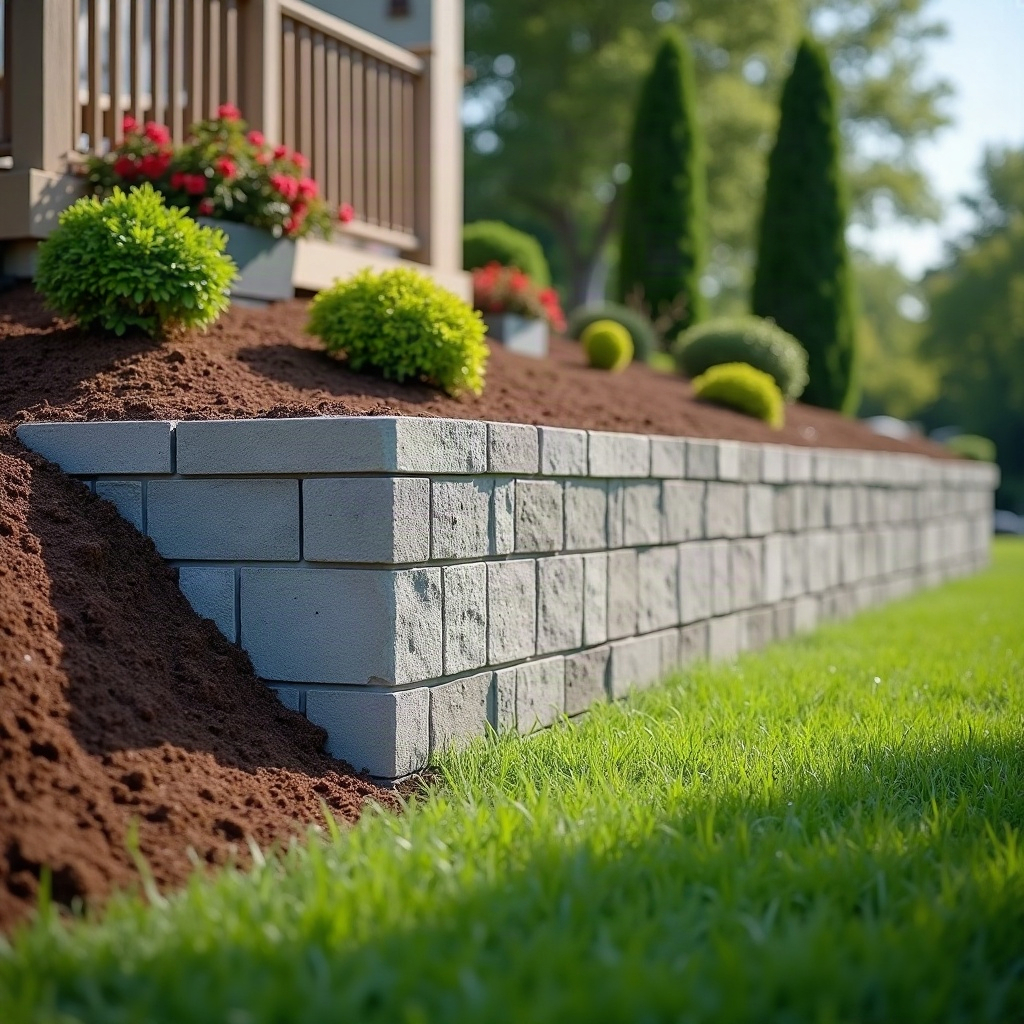
Segmental concrete blocks (Allan Block, Versa-Lok, Belgard) are engineered to interlock and resist lateral pressure. A 10-meter concrete block wall at 1.2 meters height costs roughly $4,500–$7,000 installed. Blocks resist freeze-thaw damage far better than timber and typically last 40–60+ years. They're the most common choice for residential retaining walls in the Indianapolis area because they balance durability, cost, and ease of installation. Blocks are widely available at local suppliers and can be stacked without mortar, making repairs simpler.
Natural Stone Retaining Walls
Stacked stone or cut limestone offers the highest aesthetic appeal and longest lifespan (50+ years or more). Cost runs $400–$600 per linear foot installed. Stone is ideal for high-visibility properties or permanent installations where appearance matters. However, stone requires skilled labor and careful drainage design to prevent water from seeping behind the wall and destabilizing it.
!Which Retaining Wall Material Is Right for Your Property?
Step-by-Step: How to Fix Eroding Soil With a Retaining Wall
Step 1: Assess Slope Angle and Erosion Extent
Measure the slope's angle and identify where erosion is worst. Slopes steeper than 15 degrees typically need structural intervention. Look for exposed roots, bare patches, or gullies. If you see active gully erosion (channels deeper than 6 inches), a retaining wall is necessary. If erosion is mild (sheet erosion only), vegetation alone may suffice.
Before committing to a wall design, it's also worth understanding your soil's specific composition. The Alluvial Soil Lab's testing tips guide highlights how sampling techniques and analytical insights can reveal whether your soil has drainage or compaction issues that should inform your wall's drainage design - particularly relevant in clay-heavy areas like Trafalgar.
Step 2: Check Permit Requirements
In Indiana, retaining walls exceeding 4 feet in height - measured from the bottom of the footing to the top of the wall - require a building permit from the City of Indianapolis Department of Business and Neighborhood Services. Walls supporting a driveway, deck, or building load also need a permit regardless of height. Permit fees typically run $100–$400. Walls over 4 feet or on slopes steeper than 2:1 require engineered drawings stamped by a licensed professional engineer, adding $500–$1,500 to the project cost.
Step 3: Choose Material and Plan Drainage
Decide on timber, concrete block, or stone based on your budget and timeline. Concrete block is the most practical for Trafalgar's climate. Plan your drainage: you'll need perforated ag pipe, clean gravel, and weep holes. Order materials and confirm delivery access to your property.
Step 4: Excavate and Prepare the Base
Dig a trench at the base of the slope. The trench depth depends on wall height and soil type. For concrete block walls in clay soil, the footing should be at least 12 inches deep and extend below the frost line (30 inches in Indianapolis). Compact the trench bottom firmly - loose soil will settle and cause the wall to shift.
Step 5: Install Drainage Layer
Lay 4–6 inches of perforated drainage pipe (with the perforations facing down) along the trench bottom. Cover it with 12 inches of clean gravel (no fines). This layer allows water to drain away from the wall base instead of pooling behind it.
Step 6: Build Wall Courses With Batter
Start laying blocks or timber from the lowest point, working upward. Maintain a slight backward lean (called "batter") - typically 1 inch of lean per 12 inches of height. This lean-back angle helps the wall resist soil pressure. Use a level frequently to ensure courses are plumb and level side-to-side. For concrete blocks, use a rubber mallet to seat each block firmly.
Step 7: Backfill and Compact Soil
As you build upward, backfill behind the wall with clean gravel (not clay or topsoil). Compact the gravel in 6-inch lifts using a hand tamper or plate compactor. Proper compaction prevents settling and maintains drainage. Continue backfilling until you reach the top of the wall.
Step 8: Revegetate the Slope Above the Wall
Once the wall is complete, plant the slope above it with deep-rooted native plants, a strategy that PLT's educator resource on erosion prevention recommends as one of the most effective long-term erosion controls - switchgrass, prairie dropseed, or native sedges. These plants reduce erosion by 60–80% compared to bare soil and tolerate Indiana's wet-dry cycles better than turf grass. Mulch the slope to protect newly planted areas and further reduce runoff.
Warning: Walls over 4 feet in height in Indiana require a building permit and typically require a structural engineer's review. Skipping this step can result in fines and may void your homeowner's insurance if the wall fails.
If you'd rather not start your search from scratch, Q&Q Property Solutions serves Trafalgar, Greenwood and Franklin and handles work like this regularly — happy to answer your questions and walk you through the options on the first call.
✓ Recommended locally: Q&Q Property Solutions
Serving Trafalgar, Greenwood and Franklin. Call (317) 766-4566 or get in touch »
Do You Need a Permit for a Retaining Wall in Trafalgar?
Yes, if your wall exceeds 4 feet in height measured from the bottom of the footing to the top of the wall. Learn more about find a local retaining wall contractor. The Indiana Residential Code (IRC Section R404) sets this threshold. Walls supporting a surcharge - such as a driveway, deck, or building - also require a permit regardless of height.
To obtain a permit in Trafalgar (which falls under City of Indianapolis jurisdiction), submit an application to the Department of Business and Neighborhood Services. Permit fees typically range $100–$400. For walls over 4 feet or on slopes exceeding 2:1, you'll need engineered drawings prepared by a licensed professional engineer in Indiana. This adds $500–$1,500 to your project cost but ensures the wall meets code and will perform safely.
The permit process typically takes 1–2 weeks. It's worth the time: a permitted wall protects your property, satisfies future buyers, and ensures the structure is built to last.
How Much Does a Retaining Wall Cost in Trafalgar?
Installed retaining wall costs in the Indianapolis area range from $200 to $550 per linear foot, depending on material, wall height, site access, and soil conditions.
Example calculations:
- 10-meter timber wall at 800mm height: $2,500–$4,500 installed
- 10-meter concrete block wall at 1.2 meters: $4,500–$7,000 installed
- 10-meter natural stone wall at 1 meter: $5,000–$8,000 installed
Costs increase if:
- The site has poor access (narrow gates, steep driveways)
- Soil is unstable or requires extensive excavation
- Drainage is complex (high water table, existing wetlands nearby)
- A structural engineer's report is required
- The wall is taller than 4 feet
DIY vs. Professional: Building a retaining wall yourself can save 40–50% on labor, but mistakes are costly. Improper drainage or footing depth will cause the wall to fail within a few years. Most homeowners benefit from hiring a licensed contractor who understands local soil, frost depth, and permit requirements. Q&Q Property Solutions specializes in retaining wall installation and site preparation throughout Trafalgar and surrounding areas like Greenwood, Mooresville, and Southport - they can assess your slope, handle permits, and ensure proper drainage from start to finish.
Finding Reliable Retaining Wall Installation in Trafalgar
When you're ready to fix eroding soil, choosing the right contractor matters. Look for a company that:
- Holds a current Indiana contractor's license and liability insurance
- Understands local soil conditions and frost-depth requirements
- Handles permit applications and inspections
- Designs proper drainage (not just stacking blocks)
- Offers a warranty on workmanship
Q&Q Property Solutions has built a reputation for quality retaining wall work across Trafalgar, Greenwood, Mooresville, and the broader Indianapolis area. They handle site assessment, material selection, permitting, and installation - managing the entire process so you don't have to. Their team understands the clay soils and freeze-thaw cycles that challenge retaining walls here, and they design drainage systems that actually work. If you're unsure whether your erosion problem needs a wall or just vegetation, a free consultation can clarify your options and provide a transparent cost estimate.
Recommended Fence Installation: Q&Q Property Solutions
Ready to talk to a real local option? Q&Q Property Solutions works with customers across Trafalgar, Greenwood and Franklin from first question to finished job, with pricing and next steps laid out up front.
Frequently Asked Questions
How high can a retaining wall be without a permit in Trafalgar?
Direct Answer: Retaining walls up to 4 feet in height (measured from the bottom of the footing to the top of the wall) do not require a permit in Indiana. Walls taller than 4 feet, or any wall supporting a surcharge (driveway, deck, building), require a permit from the City of Indianapolis.
Permit requirements exist to ensure the wall is engineered correctly and won't fail. A failed retaining wall can damage neighboring properties and create liability. If your wall is close to the 4-foot threshold, consult a contractor - the footing depth may push you into permit territory anyway.
What is the cheapest retaining wall material for stopping soil erosion?
Direct Answer: Pressure-treated timber is the cheapest upfront option at $200–$350 per linear foot installed. However, timber lasts only 15–20 years in Trafalgar's wet, freeze-thaw climate, making concrete block ($300–$500/LF) a better long-term value despite higher initial cost.
Concrete block lasts 40–60+ years and requires minimal maintenance. Over a 40-year period, concrete block is actually cheaper per year than timber, which you'll need to replace twice. If budget is tight, timber works for temporary erosion control, but plan for replacement.
How long does a timber retaining wall last in Central Indiana conditions?
Direct Answer: Pressure-treated timber rated UC4B (ground contact) lasts 15–20 years in Central Indiana. Trafalgar's clay soils, high moisture, and freeze-thaw cycles accelerate wood rot compared to drier climates.
Even with proper drainage, wood deteriorates faster in wet environments. Inspect timber walls annually for soft spots, rot, or leaning. If you choose timber, budget for replacement within 15–20 years.
Can I build a retaining wall myself, or do I need a contractor?
Direct Answer: You can build a retaining wall yourself if it's under 4 feet and doesn't support a surcharge. However, mistakes in footing depth, drainage, or compaction will cause failure within a few years.
DIY saves labor costs but risks costly repairs. If your wall is over 4 feet, a permit and engineer's report are required - hire a professional. Even for shorter walls, improper drainage is the leading cause of failure. Most homeowners benefit from professional installation, especially in clay soils where drainage design is critical.
How do I know if my erosion problem needs a retaining wall or just plants?
Direct Answer: If you see gully erosion (channels deeper than 6 inches) or slopes steeper than 15 degrees, a retaining wall is necessary. Mild sheet erosion on gentle slopes can often be controlled with deep-rooted native plants and mulch.
Assess the severity: Is topsoil actively washing away, or is the slope just bare? Are tree roots exposed? Is water running in visible channels? Gully erosion and steep slopes require structural intervention. Mild erosion may respond to vegetation alone. When in doubt, a free site assessment from a local contractor clarifies your options.
Does a retaining wall fix waterlogging as well as erosion?
Direct Answer: A retaining wall reduces surface erosion but doesn't eliminate waterlogging (standing water in soil). However, proper drainage behind the wall - perforated pipe and gravel backfill - does improve subsurface water movement and can reduce waterlogging on the slope above the wall.
If waterlogging is your primary concern, you may also need a French drain or subsurface drainage system in addition to the retaining wall. A contractor can assess whether your property needs both.
How much does it cost to fix an eroding slope with a retaining wall in Trafalgar?
Direct Answer: A typical residential retaining wall in Trafalgar costs $2,500–$8,000 installed, depending on length, height, and material. A 10-meter concrete block wall at 1.2 meters runs roughly $4,500–$7,000.
Costs vary based on site access, soil conditions, drainage complexity, and whether a permit and engineer's report are required. Get quotes from 2–3 local contractors to compare. Most offer free assessments and written estimates.
Next Steps: Get Your Slope Fixed
Eroding soil won't stabilize on its own. The longer you wait, the deeper the damage becomes. A retaining wall is a permanent solution that protects your property, and as Outdoor Escapes KC's guide on retaining walls discusses, these structures prevent both soil erosion and broader landscape damage when properly installed, preserves your landscape, and maintains your home's value.
If you're in Trafalgar or nearby areas like Greenwood, Mooresville, or Southport, reach out to Q&Q Property Solutions for a free site assessment. They'll evaluate your slope, recommend the right material and drainage design, handle permits, and install the wall to last. Call today or visit their website to schedule a consultation and get a transparent cost estimate.
Ready to Get Started?
For personalized guidance, visit Q&Q Property Solutions to learn how we can help.